Instant 3D Printing Quotes: How Service Bureaus Turn File Uploads into Paid Orders
Why Instant Quoting Matters in 3D Printing
Additive manufacturing is built around digital files. A customer can design a bracket, enclosure, jig, miniature, dental model, prototype, or replacement part on one side of the world and send it to a production partner in seconds. That digital workflow creates an obvious expectation: if the file can be uploaded instantly, the first price estimate should not take a full business day.
Yet many 3D printing businesses still quote like traditional job shops. A customer submits an STL, OBJ, or 3MF file through a form. Someone on the production team downloads it, opens slicer software, checks dimensions, estimates material usage, chooses a printer, thinks through support needs, adds a markup, and writes back by email. If the customer asks for a different material, quantity, color, or lead time, the process starts again.
Manual quoting is not automatically bad. Complex industrial parts, regulated medical workflows, high-value engineering projects, and finishing-heavy orders may always need human review. But manual quoting becomes a growth bottleneck when every small order needs the same level of attention. It slows down buyers, consumes production time, and makes pricing inconsistent across teams.
For a modern 3D printing service, quoting is no longer just an administrative step. It is part of the customer experience. A clear, fast, and credible price can move a visitor from curiosity to checkout. A delayed or vague response can send that same visitor to a competitor with a faster workflow.
That is the business case for instant 3D printing quotes.
The Market Is Moving Toward Digital, On-Demand Manufacturing
3D printing is not only a prototyping novelty. The National Institute of Standards and Technology describes additive manufacturing as a digital-design-driven process that builds three-dimensional products layer by layer, with potential advantages for complex designs, material efficiency, and industrial adoption. McKinsey has also noted that additive manufacturing has moved beyond simple experimentation in several sectors, especially where customization and high-value applications justify the workflow.
This matters for service bureaus because customer expectations are changing along with the technology. Buyers are no longer only hobbyists asking for a single PLA part. They may be engineers testing a functional prototype, product teams comparing iterations, maintenance teams sourcing replacement components, agencies ordering display models, or small brands creating low-volume production runs.
Market estimates vary by methodology, but the direction is consistent: 3D printing is expected to keep growing across printers, materials, software, and services. MarketsandMarkets, for example, projects the 3D printing market to grow from USD 16.43 billion in 2026 to USD 31.77 billion by 2032. The same report points to demand for customized products, low-volume production, faster design iteration, and shorter time-to-market as growth drivers.
Those trends favor businesses that can respond quickly. When customers are comparing suppliers online, the fastest reliable quote often has a practical advantage. The goal is not to make pricing feel rushed. The goal is to make the buying path feel professional, transparent, and ready.
The Hidden Cost of Manual 3D Printing Quotes
Manual quoting feels manageable when order volume is low. One person can review a few files per week and send carefully written responses. But as traffic grows, the cost becomes harder to ignore.
First, manual quoting takes skilled time away from production. The person who understands machine profiles, material behavior, support strategy, and post-processing is often the same person needed on the shop floor. Every repetitive quote delays scheduling, quality control, packing, or customer support.
Second, manual quoting can create inconsistent prices. Two team members may evaluate the same model differently. One may include support removal labor while another forgets it. One may charge machine time correctly while another uses only material weight. One may apply a minimum order value while another discounts too early. Over time, inconsistent pricing can train customers to negotiate and make margin harder to protect.
Third, manual quoting adds friction exactly when customer intent is high. A visitor who uploads a 3D file is not simply browsing. They are close to asking, "Can you make this, how much will it cost, and when can I get it?" If the answer is "we will email you later," the business is asking that visitor to pause the buying process.
This is especially important when 3D printing is sold through an eCommerce-style journey. Baymard Institute's checkout research has tracked global cart abandonment for years and reports a current average cart abandonment rate of 70.19%. Baymard's research also identifies checkout friction, late cost visibility, and poor checkout UX as conversion problems. A 3D printing quote is not identical to a standard eCommerce cart, but the lesson transfers: customers are more likely to continue when cost, options, and next steps are visible early.
Manual quoting can be useful for complex jobs. It should not be the default gate in front of every order.
What an Instant 3D Printing Quote Actually Needs to Calculate
An instant quote is only useful if it reflects production reality. A simplistic calculator that multiplies filament grams by a markup may look fast, but it can quietly damage profit. 3D printing cost depends on more than material.
A credible quote needs to account for geometry, technology, material, machine time, support needs, quantity, post-processing, risk, overhead, margin, and taxes. It also needs to know when not to provide an automatic checkout price. If a file has thin walls, non-manifold geometry, extreme overhangs, unusual scale, or finishing requirements that cannot be modeled reliably, the system should route it to manual review.
The best automated quoting systems do not remove expert judgment. They reserve expert judgment for the jobs that actually need it.
Core pricing variables
Pricing variable | Why it matters | Example impact |
|---|---|---|
Model volume | Drives material consumption | A dense part can cost more even if it looks small |
Surface area | Affects finishing, exposure, and processing assumptions | High-detail surfaces may need slower settings or more care |
Dimensions | Determines whether the part fits the selected printer | Oversized parts may require scaling, splitting, or a larger machine |
Print time | Captures machine occupancy | A low-weight part can still tie up a machine for many hours |
Support volume | Adds material, labor, and risk | Overhang-heavy parts can become more expensive than expected |
Technology | FDM, SLA, and SLS use different production logic | Resin curing and SLS powder handling differ from filament printing |
Material | Changes cost, speed, risk, and finishing | PLA, ABS, resin, nylon, and engineering materials behave differently |
Quantity | Affects batching and fixed cost allocation | Ten parts may not cost exactly ten times one part |
Post-processing | Adds labor and consumables | Washing, curing, sanding, dyeing, painting, and inspection should be priced |
Risk | Protects against failed prints and manual intervention | Thin walls or poor geometry may require review |
This is why instant quoting depends on file analysis, not just a form. The uploaded model must be measured and interpreted before the business can show a reliable price.
FDM, SLA, and SLS Quotes Should Not Use the Same Logic
Many 3D printing services offer multiple technologies, but still price them with overly similar formulas. That can create problems because FDM, SLA, and SLS have different cost structures.
FDM quoting
Fused Deposition Modeling is often the most accessible and cost-effective option for prototypes, jigs, fixtures, enclosures, and functional plastic parts. A strong FDM quote should consider filament usage, layer height, nozzle size, wall count, infill, support material, print speed, bed adhesion, machine occupancy, and material-specific risk.
For example, two parts may use the same amount of filament but require very different print times. A part with fine layer height, heavy support, or slow flexible material can occupy a printer far longer than a simple PLA bracket. If pricing is based only on grams, the business may undercharge for machine time.
SLA quoting
Stereolithography is often chosen for smooth surfaces, fine detail, jewelry models, dental applications, miniatures, and visually demanding prototypes. SLA pricing must account for resin volume, layer count, exposure behavior, lift and retract movement, support density, washing, curing, support removal, and handling risk.
Resin parts can also require more careful post-processing than customers expect. The quoted price should make room for washing, curing, support removal, and quality inspection when those steps are part of the service.
SLS quoting
Selective Laser Sintering is attractive for functional nylon parts, complex geometries, and small-batch production because it does not require support structures in the same way as FDM or SLA. But SLS has its own logic: powder usage, powder refresh ratios, nesting efficiency, laser scanning behavior, cooling time, depowdering, and batch planning.
SLS pricing becomes especially sensitive to build volume utilization. A single part may be expensive if it occupies a low-efficiency build, while a well-nested batch can share fixed costs more effectively. A serious instant quoting system should understand this difference instead of treating SLS as "material plus markup."
How Instant Quoting Improves Customer Acquisition
Search traffic is valuable only when it becomes a qualified conversation or a paid order. A blog post, ad, marketplace listing, or product page may bring a visitor to the site, but the quoting flow decides whether that visitor moves forward.
Instant quoting helps customer acquisition in five practical ways.
1. It captures high-intent visitors while they are ready
A customer with a model file is already further along than a general reader. They may have searched for "3D printing quote," "print STL online," "SLS nylon part price," or "custom 3D printing service." If they can upload the file and see an estimate immediately, the business can engage them at the moment of intent.
If the flow requires a form and a delayed email, the customer has time to open other tabs, compare competitors, or postpone the project. Speed does not guarantee a sale, but it reduces the chance that interest cools before the first price appears.
2. It makes pricing feel transparent
Customers do not need to see every internal calculation, but they do need to understand what affects the price. Technology, material, layer height, color, quantity, and post-processing options should feel connected to the final quote. When changing a selection updates the price, the customer learns the cost drivers without needing a long explanation.
Transparency also reduces back-and-forth. Instead of asking, "Why is this so expensive?" the customer can see that the selected resin, finish, quantity, or rush option changes the result.
3. It protects the sales team from low-value repetition
Not every inquiry deserves a custom sales cycle. A small PLA prototype, a simple replacement cap, or a basic display model should not require multiple emails. Automated quoting lets the team focus on large orders, engineering questions, enterprise accounts, and jobs that need real consultation.
This can improve both responsiveness and quality. Customers with simple jobs get fast answers. Customers with complex jobs get better human attention.
4. It creates a cleaner path from upload to checkout
Quote3D's widget documentation describes an embeddable quoting experience that can provide an interactive model preview, instant pricing, support for FDM, SLA, and SLS, and integration options for platforms such as WooCommerce and Shopify. It can also connect quote events to cart behavior, helping turn model uploads into eCommerce actions.
For a service bureau, this is powerful because the quote is no longer a dead-end estimate. It can become the start of a checkout flow, lead capture process, or production workflow.
5. It standardizes the promise made to customers
A quote is a promise. If the number is too low, production loses margin. If the number is too high, the customer may leave. If the same part receives different prices from different people, trust suffers.
Automated quoting helps apply the same rules every time. Printer profiles, material settings, fixed fees, margins, taxes, and post-processing options can be configured once and reused across orders. Human review can still be added where needed, but the baseline becomes more consistent.
The Best Instant Quote Flows Still Know When to Stop
There is a temptation to automate everything. In 3D printing, that can be risky. Some files should not receive an automatic checkout price.
Examples include:
Models with non-manifold geometry or open edges
Parts that do not fit the selected printer's build volume
Files with unit scale anomalies, such as inch-based files interpreted as millimeters
Thin walls below material or nozzle limits
Large unsupported overhangs
Parts that require premium finishing or assembly
High-value industrial parts that need engineering review
Regulated or safety-critical applications
Quote3D's quickstart documentation points to printability checks, file upload workflows, asynchronous quote jobs, quote history, webhooks, analytics, and usage tracking. This kind of structure matters because an automated system should be able to separate "ready for instant quote" from "needs review."
The ideal customer experience is not "every file gets a price at any cost." It is:
Simple jobs receive a fast, confident quote.
Risky jobs receive a clear explanation and are routed to review.
Customers always know what happens next.
That balance protects both conversion and production quality.
What Quote3D Adds to a 3D Printing Business
Quote3D is built for 3D printing services and small print farms that want to generate quotes from uploaded 3D model files. Its public site and documentation describe support for STL, 3MF, and OBJ uploads, FDM, SLA, and SLS workflows, file analysis, printability checks, material usage estimates, print time estimates, API integration, widget embedding, and webhook-based workflow automation.
For a business owner, that matters in practical terms.
Instead of asking a developer to build a geometry analysis and pricing engine from scratch, the business can use a quoting layer designed around the 3D printing workflow. Instead of forcing every customer through email, the site can offer a file upload and quote experience. Instead of manually copying data into production systems, the business can use API endpoints and webhooks to connect quotes to internal tools.
Widget for fast customer-facing quoting
The Quote3D Embed Widget is positioned as a no-code or low-code way to add a quoting experience to a website or eCommerce platform. It supports interactive model preview, instant pricing, multiple 3D printing technologies, theme customization, and integrations for platforms such as WooCommerce and Shopify.
This is useful for businesses that want customer-facing quoting quickly. A print shop can place the widget on a quote page, configure materials and printers, and start collecting higher-quality quote requests with uploaded files and calculated prices.
API for custom workflows
The Quote3D API supports a more developer-driven workflow. According to the quickstart documentation, external integrations use https://api.quote3d.com/v2, authenticate with a Bearer token, upload files, check printability, start quote jobs, poll job status, and retrieve quote details.
This is useful when a business wants quoting inside a custom portal, ERP flow, CRM, production dashboard, marketplace, or internal admin system.
Webhooks for operational automation
Quote3D's webhook documentation describes real-time notifications for events such as completed quotes, failed quotes, uploaded files, deleted files, job status changes, and widget add-to-cart actions. Webhooks can trigger follow-up actions such as updating order status, notifying a customer, or starting a production job.
For growing service bureaus, this is where quoting becomes more than a calculator. It becomes part of an automated operating system.
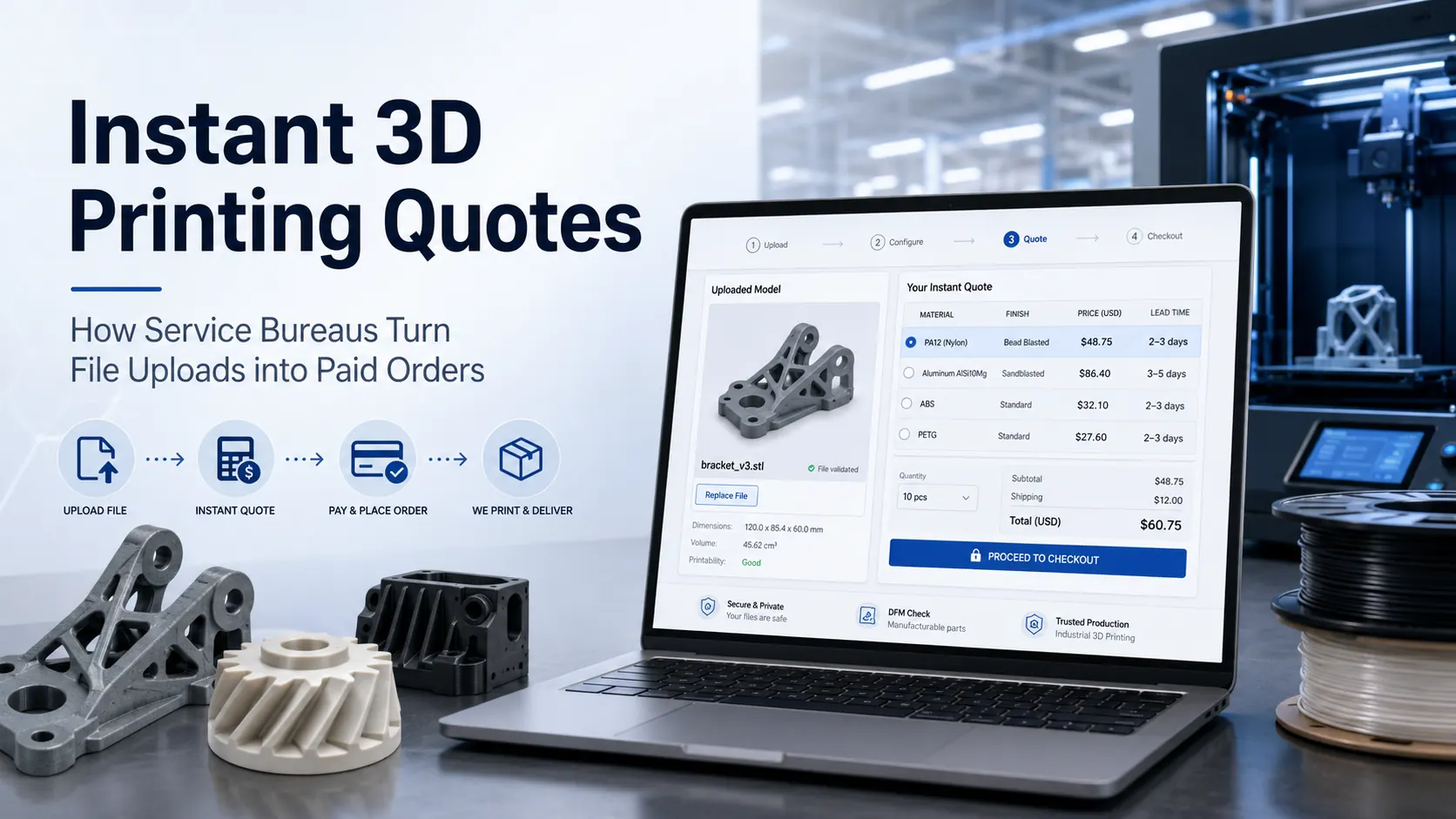
A Practical Upload-to-Order Workflow
A strong instant quote workflow can be simple from the customer's point of view while still being sophisticated behind the scenes.
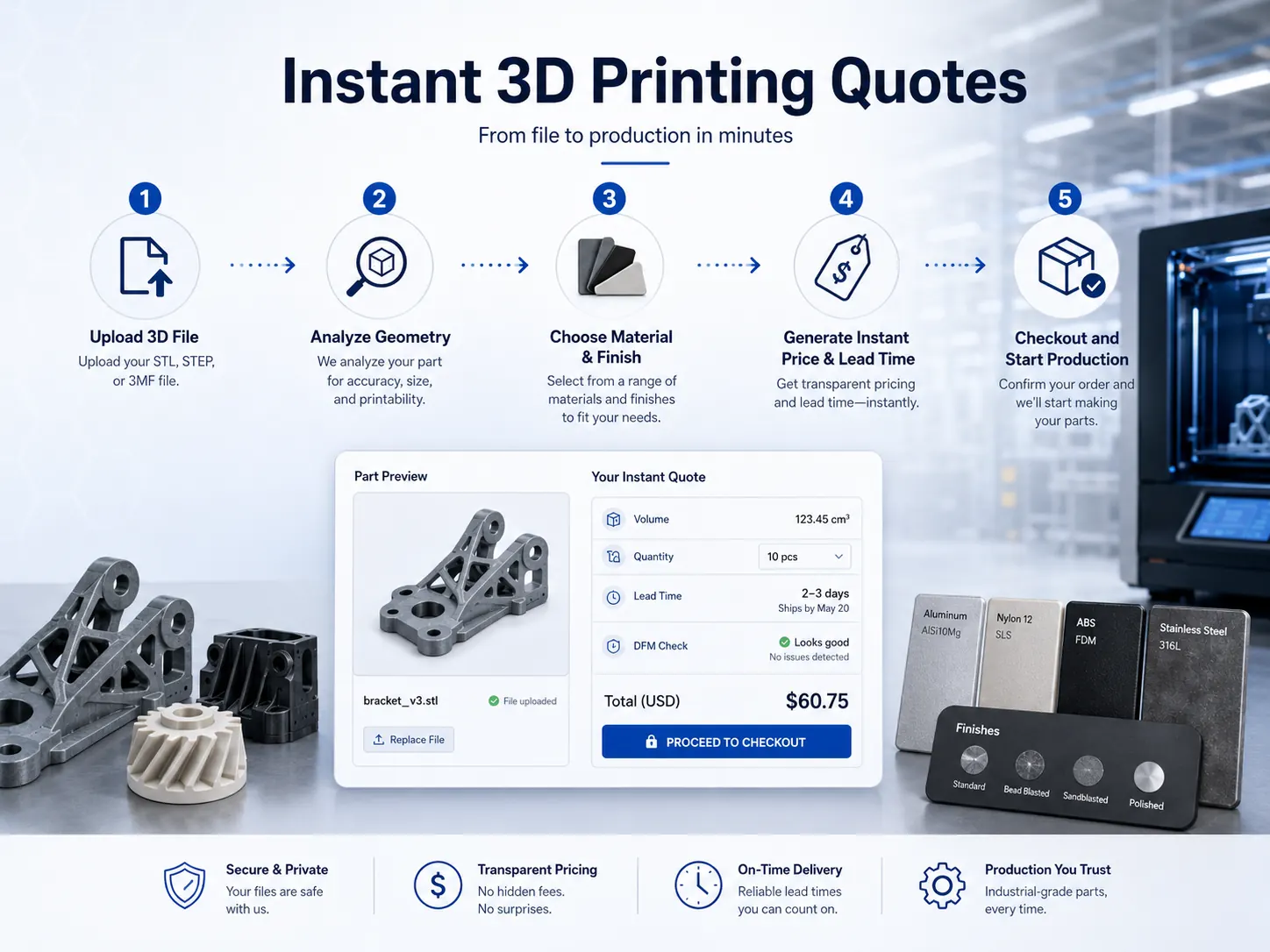
Step 1: Customer uploads a model
The customer drops an STL, OBJ, or 3MF file into the quote tool. The page should clearly show accepted file types, maximum file size, and upload progress. If the business serves both casual and professional users, the copy should be plain and direct.
Step 2: The system analyzes the file
The quoting engine measures dimensions, volume, surface area, and other geometry factors. It checks whether the part fits the selected printer profile and whether obvious file issues should block instant checkout.
Step 3: Customer selects production options
The customer chooses technology, material, color, layer height, infill, quantity, and post-processing options where relevant. The interface should avoid overwhelming non-technical buyers, but it should provide enough control for users who know what they need.
Step 4: Quote rules calculate the price
The system applies material costs, machine time, support assumptions, fixed fees, margins, taxes, and other configured pricing rules. The result should be fast enough to feel interactive and detailed enough to protect the business.
Step 5: The customer sees the result
The quote should present the total price, selected configuration, estimated production time or print time where appropriate, and any warnings. If the job requires manual review, the page should say so clearly and collect the right contact details.
Step 6: The quote becomes a cart item or lead
For standard jobs, the customer can add the configured part to the cart. For complex jobs, the system can create a lead with the model file, configuration, customer details, and quote context. Either path is better than losing the uploaded file inside a generic contact form.
Step 7: Operations receives structured data
The production team should not need to reconstruct the customer's request from email text. The quote should carry file ID, material, technology, quantity, selected options, price, and analysis results into the next system.
How to Make Instant Quotes Trustworthy
Instant quotes need trust. If customers suspect that the number is random, they will hesitate. If production teams suspect that the number is risky, they will resist using it.
Here are the most important trust builders.
Show the customer what changed the price
A quote does not need to expose private margins, but it should explain visible inputs. Technology, material, quantity, layer height, post-processing, and lead time are understandable cost drivers. Showing them clearly makes the quote feel less arbitrary.
Use minimum order values and setup fees
Small parts can be deceptively unprofitable. A tiny print may use very little material, but still requires upload handling, machine setup, packing, payment processing, and customer support. Minimum order values or setup fees help protect margin without distorting every material price.
Separate standard and manual-review jobs
Do not force automation to approve files that deserve review. If a part is too large, too thin, too risky, or too finishing-heavy, the best conversion path may be a fast manual review request rather than a fragile instant checkout price.
Configure technology-specific rules
FDM, SLA, and SLS should have separate assumptions for print time, support behavior, labor, post-processing, and batching. Customers may only see a simple dropdown, but the business should not use one generic formula behind the scenes.
Review quote outcomes regularly
Automation should improve with real production feedback. Compare quoted print times with actual print times. Compare expected material usage with real usage. Track which jobs were routed to manual review and why. Adjust rules when production data shows a pattern.
A Simple Readiness Checklist
Before adding instant 3D printing quotes to a website, a service bureau should answer these questions.
Question | Why it matters |
Which technologies will be quoted automatically? | FDM may be ready before SLA or SLS depending on your process maturity |
Which file formats will you accept? | Customers need clear upload rules |
Which printer profiles are production-ready? | Build volume, speed, and cost assumptions must be accurate |
Which materials can be safely quoted online? | Some materials may need special handling or review |
What is the minimum profitable order value? | Prevents small orders from consuming margin |
Which jobs require manual review? | Protects quality and avoids impossible promises |
How will quoted orders enter production? | Avoids manual copying after checkout |
How will you update pricing rules? | Keeps automation aligned with real costs |
If these answers are clear, instant quoting can become a growth tool rather than just a website feature.
Final Takeaway
The most successful 3D printing services will not be the ones that automate every decision blindly. They will be the ones that automate the repetitive parts of quoting, standardize their pricing logic, and keep expert review for the jobs where it adds real value.
Instant quoting helps because it matches how customers already think. They have a file. They want to know whether it can be printed. They want to compare material and technology options. They want a price before momentum disappears.
For service bureaus, small print farms, and eCommerce-driven 3D printing businesses, Quote3D offers a practical way to build that experience. With support for 3D model uploads, FDM/SLA/SLS quote logic, printability checks, widget embedding, API workflows, and webhooks, it helps turn a slow quote inbox into a structured path from upload to order.
In a market where customization, speed, and digital manufacturing are becoming more important, the quote itself is part of the product. Make it fast, make it accurate, and make it easy for the customer to say yes.